Engineers are available to assist.


|
|
Unique absorption properties allow 2µm lasers to create small and precise cuts |
|
|
Minimal thermal injury zone in medical laser applications due to absorption in water |
|
|
Ideal for materials processing applications such as polymer processing |
|
|
Recent advances in 2µm lasers have increased efficiency, ease of use, and stability |
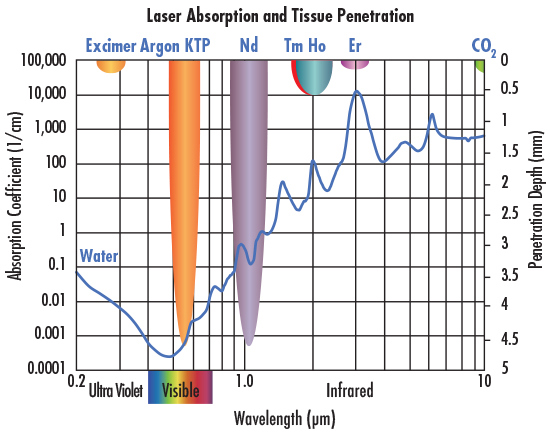
Biological tissue, polymers, and numerous other materials have unique absorption properties at wavelengths around 2µm, allowing lasers in that spectral region, such as thulium (2080nm) and holmium (2100nm) lasers, to heat very small areas with minimal damage to the surrounding regions. This makes 2µm lasers ideal for a wide variety of applications including materials processing and laser surgery. While 2µm lasers have been around for decades, recent advances in their design have greatly improved their accessibility, power efficiency, and stability. UV and 1µm lasers have different absorption characteristics and are unable to meet the needs of these specific materials processing and medical applications.
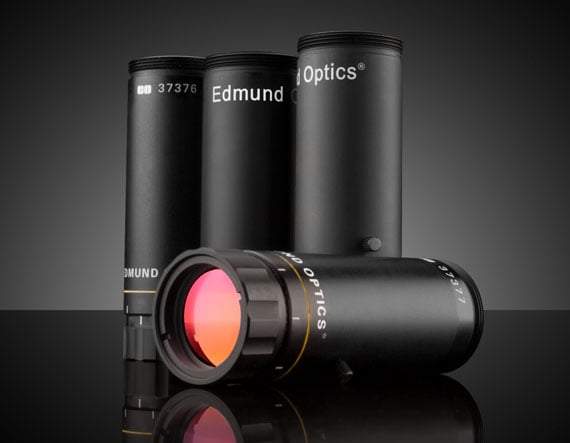

The compact TECHSPEC® Vega Broadband Beam Expanders are ideal for demanding applications using 2µm lasers and tunable laser sources. A threaded barrel divergence adjustment allows them to compensate for varying input beam divergence while maintaining λ/10 transmitted wavefront error and high transmission from 1900-2100nm. They are available with fused silica 7979 and fused silica 7980 substrates.
Learn More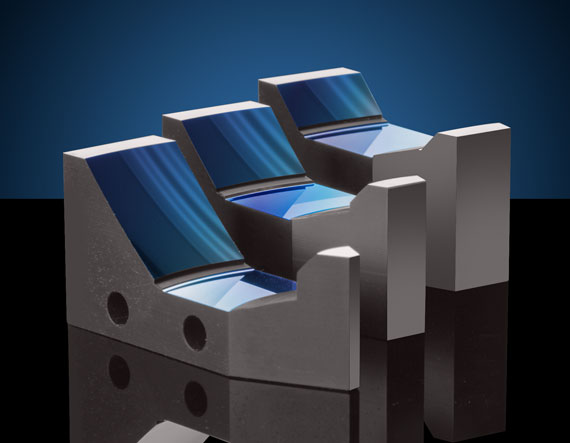
The broadband and achromatic TECHSPEC® Canopus Reflective Beam Expanders feature a variety of integrated design elements for easy integration, including reflective flats, thread holes, and thru-holes, simplify alignment, mounting, and integration into any laser application. The monolithic design ensures performance and stability independent of changes in temperature.
Learn More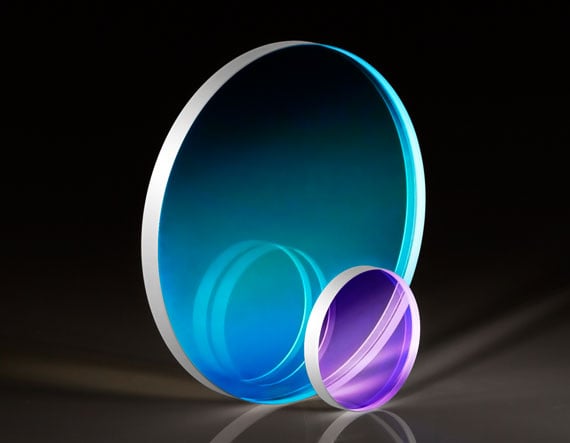
The TECHSPEC® λ/10 UV Fused Silica Windows feature a transmitted wavefront distortion less than λ/10 along with laser-grade parallelism and surface quality. 2µm antireflection (AR) coated versions are available to minimize reflections in 2µm laser applications. They offer excellent thermal properties, high transmission, and tightly controlled manufacturing tolerances.
Learn More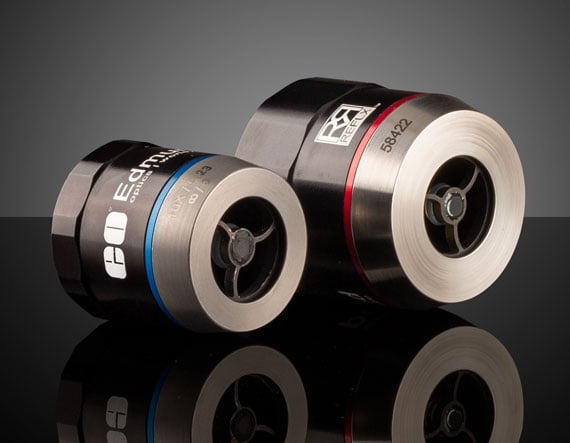
The reflective ReflX™ Objectives feature a broad spectral range and near-diffraction performance, resulting in superior image quality. By utilizing reflective mirrors instead of transmissive optics, these objectives do not suffer from the material absorption and chromatic aberration associated with standard microscope objectives. A variety of different coating options are available for 2µm applications.
Learn More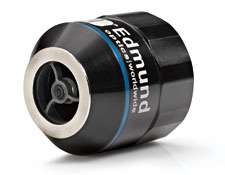
The TECHSPEC® High Performance ReflX™ Objectives feature the same broad spectral range as our standard ReflX™ Objectives along with λ/4 P-V transmitted wavefront error and a tapered mechanical design allowing them to be used at angles of incidence up to 45°. A variety of different coating options are available for 2µm applications.
Learn More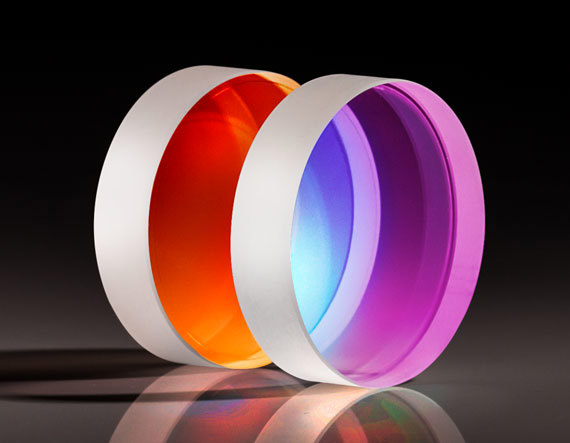
The TECHSPEC® 2µm Laser Line Mirrors are ideal for use with Thulium (1940nm) and Holmium (2100nm) doped lasers in medical, industrial, and metrology applications. They feature reflectivities >99% at 2µm and guaranteed laser damage thresholds >10 J/cm2.
Learn More 2µm lasers are not a new invention, so why are they a current trend in the optics industry?
Is it better to use a continuous wave or pulsed 2µm laser for materials processing?
2µm lasers are not a new invention, so why are they a current trend in the optics industry?
Is it better to use a continuous wave or pulsed 2µm laser for materials processing?
Continuous wave (CW) 2µm lasers create heat-affected zones at the top and bottom surfaces during laser materials processing, which reduces the precision of the process. On the other hand, pulsed 2µm lasers create smaller heat-affected zones, leading to less surface damage and more precise processes.
Why are 1µm lasers not as effective in surgical applications as 2µm lasers?
Radiation from 1µm lasers has much lower absorption than 2µm lasers and penetrates deeper into tissue, resulting in larger areas of injury and more unnecessary dead tissue. Because surgery is a very precise process, the depth of cuts need to be finely controlled in order to reduce damage to the underlying tissue. 2µm lasers offer this precision and should be considered for these surgical applications.
What optical materials are compatible with 2µm lasers?
Some of the most common materials for use in the 2µm spectral region are fused silica, zinc selenide, calcium fluoride (CaF2), germanium, and sapphire. More information about compatible optical materials and their properties can be found at our Characteristics of 2µm Lasers application note.









or view regional numbers
QUOTE TOOL
enter stock numbers to begin
Copyright 2023, Edmund Optics Inc., 101 East Gloucester Pike, Barrington, NJ 08007-1380 USA
California Consumer Privacy Acts (CCPA): Do Not Sell or Share My Personal Information
California Transparency in Supply Chains Act
This content may include material that has been generated or modified using artificial intelligence (AI).
The FUTURE Depends On Optics®